
Engineering intelligence. Enabling autonomy.
Aetheron Autonomous Systems is an emerging Indian deep-tech company that designs intelligent autonomous systems for real-world challenges, from medical logistics and emergency response to industrial automation and agriculture.

UAVs, VTOL aircraft and aerial mobility.
Autonomous ground robots and rovers.
AI, perception, navigation and autonomous control.
Six divisions built around autonomy.
We combine mechanical design, propulsion, embedded electronics, navigation, computer vision and intelligent control to build reliable, mission-oriented platforms.
Aerospace & UAV Systems
- UAVs and VTOL platforms
- Tilt-rotor, fixed-wing and multirotor aircraft
- Heavy-lift cargo and aerial mobility platforms
- Medical logistics and emergency-response aircraft
Autonomous Ground Robotics
- Autonomous mobile robots (AMRs) and unmanned ground vehicles (UGVs)
- Industrial and agricultural rovers
- Robotic inspection platforms and autonomous mobility
- Human-robot collaboration systems
Artificial Intelligence & Autonomy
- AI-based decision-making and mission planning
- Computer vision, object detection and perception
- Sensor fusion, machine learning and edge AI
- Autonomous fleet coordination
Navigation, Avionics & Control
- Flight controllers, embedded electronics and telemetry
- GNSS and inertial navigation
- LiDAR and multi-sensor integration
- Guidance, navigation and control systems
Research, Development & Manufacturing
- Aerospace product and mechanical engineering
- Structural design, prototyping and testing
- Composite structures and propulsion integration
- System integration and manufacturing development
Specialized Autonomous Applications
- Medical logistics and emergency response
- Agriculture and precision monitoring
- Industrial and infrastructure inspection
- Disaster management and lawful security applications
Unmanned air ambulance, designed in India.
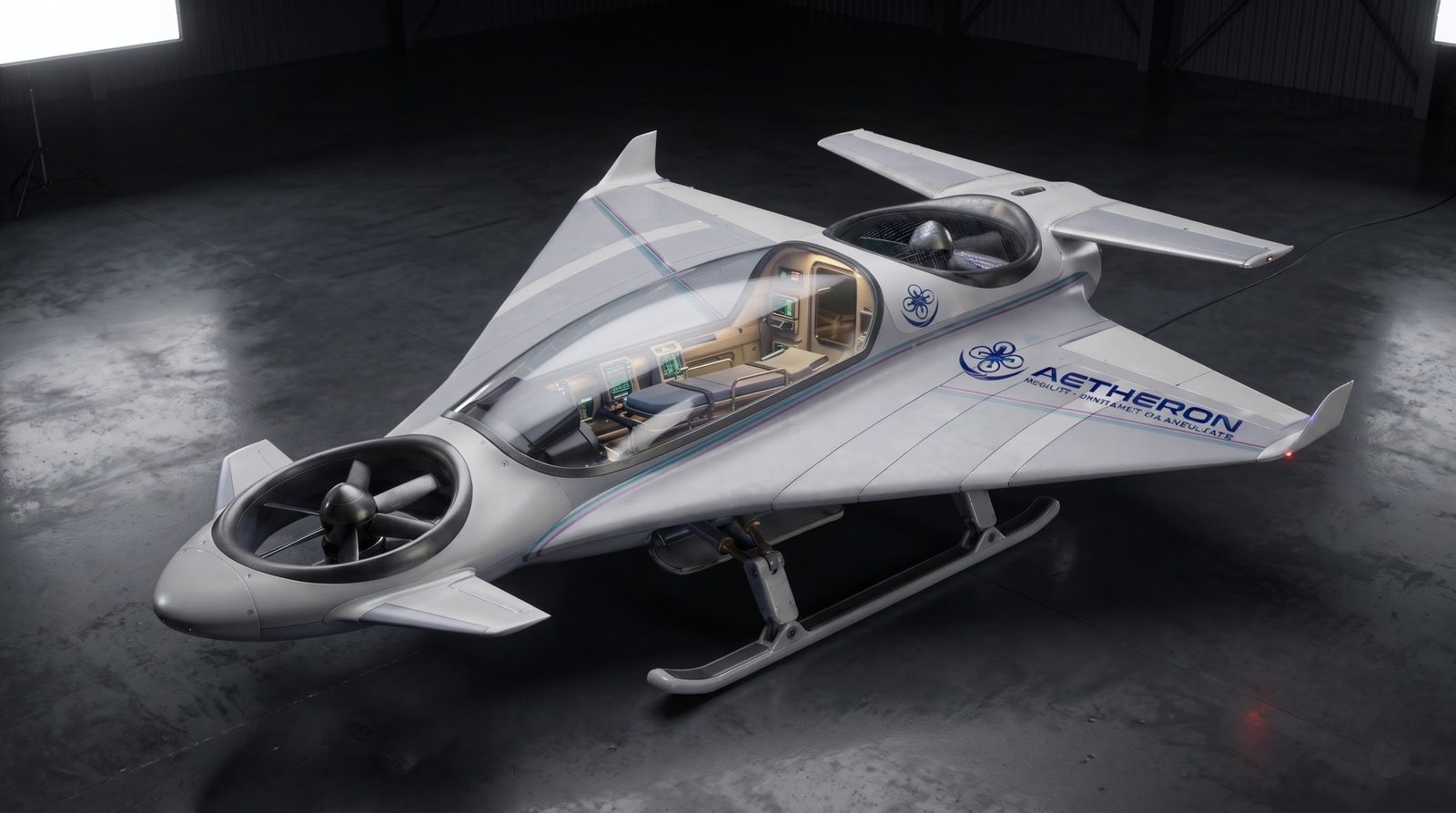
Aetheron MediLift is a tilt-rotor VTOL aircraft that lifts off vertically from a hospital terrace or a disaster site, then flies forward on fixed wings to reach advanced care within the golden hour.
Time-critical care is stuck between slow roads and costly helicopters.
Blood, organs, medicines and, in future, patients need to move from remote, mountainous, disaster-hit or congested areas to advanced hospitals. Today's options each fall short.
Ground ALS ambulances
Delayed by traffic and terrain.
Manned helicopters
Need pilots and heavy infrastructure, and are costly to operate.
Standard multirotor drones
Lack the speed and range to cover inter-city distances.
Lifts like a helicopter. Cruises like a plane.
MediLift points its rotors up for vertical take-off and landing, then tilts them forward so the wings carry the aircraft in efficient, faster forward flight.
Vertical take-off
The rotors point upward, so the aircraft lifts off from a hospital helipad or small clearing without a runway.
Transition and cruise
Once airborne, the rotors tilt forward and the wings carry the aircraft in energy-efficient, faster flight. Target: 120+ km/h.
Precision delivery
The aircraft returns to hover for a vertical landing at the destination, where the payload is retrieved.
Tilt-rotor VTOL architecture
Vertical lift combined with the aerodynamic efficiency of a fixed wing, for better speed and range.
Transition flight control
Software manages the hover-to-cruise change, the most critical flight phase, with fault handling designed in.
Modular medical payload pod
A shock-absorbing, climate-controlled bay for organs and blood, and in future a patient module.
Remote supervision and BVLOS
Beyond-visual-line-of-sight operation with redundant telemetry, so one remote pilot can supervise a mission.
Tilt-rotor is one of several VTOL-plus-wing configurations. Aetheron chose it for hover capability plus efficient cruise. These benefits are design targets and have not yet been demonstrated.
If it cannot land, it lowers the cargo on four cables.
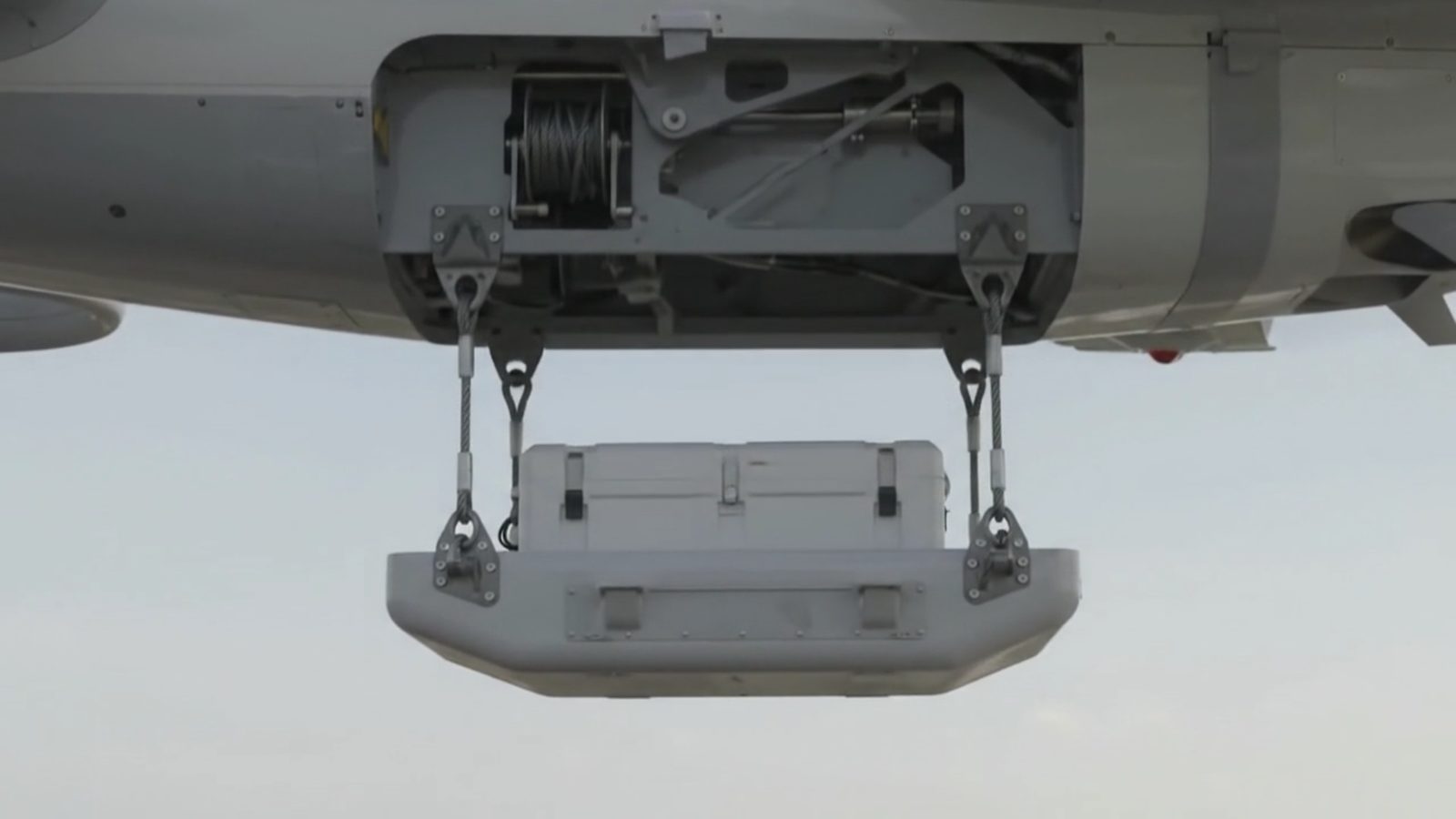
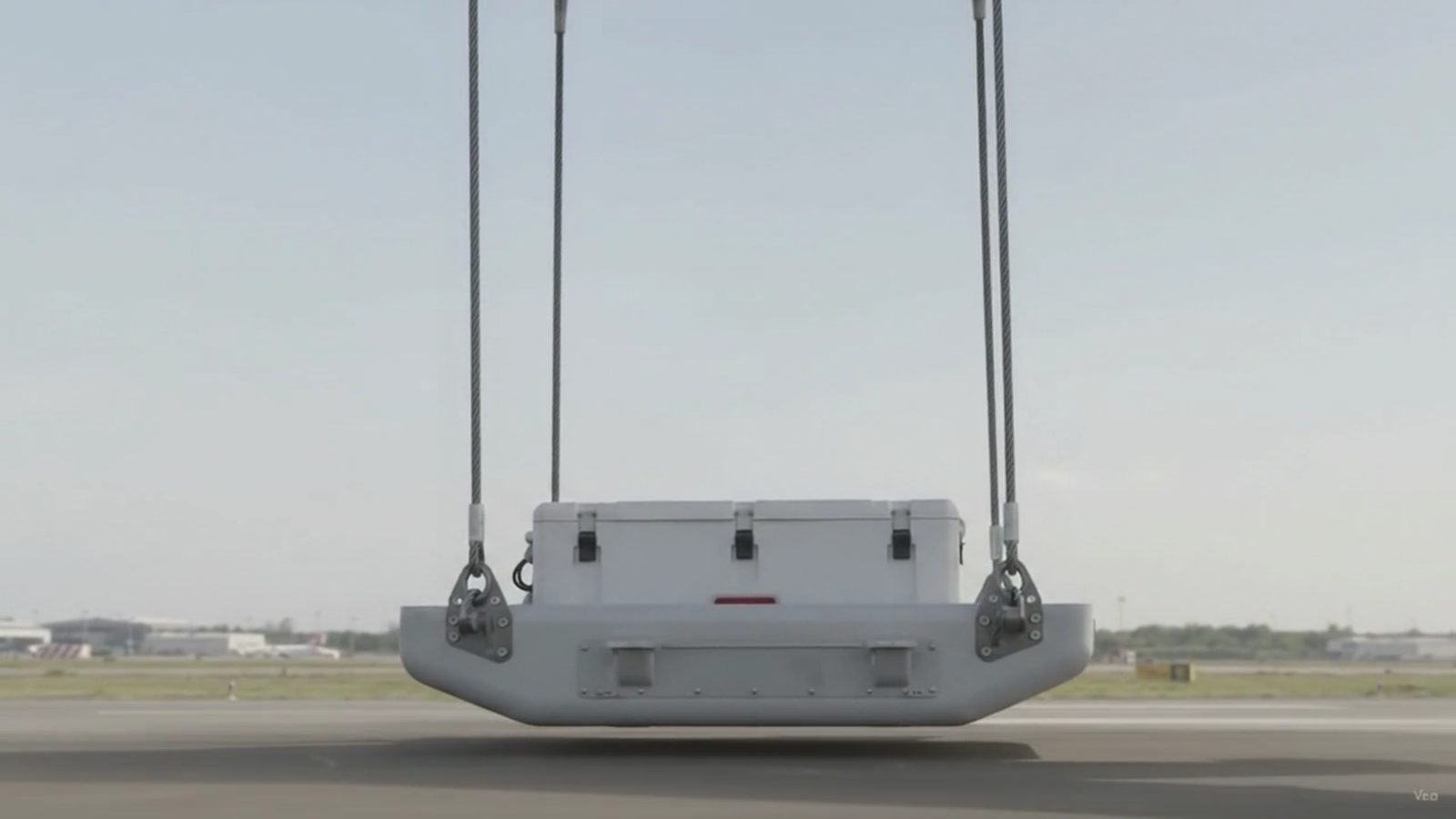
Some drop zones have no safe space to touch down. MediLift can hold a hover above the site and lower the payload pod to the ground from a winch bay under the fuselage.
Hold position
The aircraft arrives over the drop point and hovers when there is no safe space to land.
Lower on four cables
The winch lowers the pod to the ground on four cables, so the payload reaches the site without the aircraft touching down.
Collect and retract
The receiving team collects the cargo and the cables are retracted. The aircraft then flies on.
The cables are used only for delivery and pickup. They are not a way to carry a load in flight.
One airframe, a second job: police patrol and reconnaissance.
The payload pod is modular. Swap the medical pod for a sensor pod and the same aircraft can support public-safety teams that need to see a large area quickly.
Patrol support from the air
A MediLift fitted with a camera pod can extend a patrol team’s reach over highways, large events and areas that are slow to reach by road.
- Monitoring of highways, crowds and event perimeters
- Day and night search for missing persons with an optical and thermal camera
- Looking over an accident scene before the first ground unit arrives
- Dropping a first-aid kit or defibrillator at the scene on four cables
Looking before people go in
Aerial reconnaissance gives responders a view of a site that is unsafe, cut off or too large to inspect on foot.
- Flood, landslide and cyclone damage assessment
- Locating stranded people and passable access routes
- Inspecting fire, collapse and industrial incident sites from a safe distance
- Live video to a control room so teams are sent where they are needed
| Requirement | What MediLift offers (target) | Still open |
|---|---|---|
| Range and endurance | Wing-borne cruise is meant to cover long routes without refuelling stops. Target: 120+ km/h. | Endurance with a sensor pod is not yet estimated. |
| Take-off and landing | Vertical take-off from a station roof, police ground or small clearing. No runway. | Safe landing zones in crowded areas. |
| Payload | The 120 kg payload class has room for a camera and thermal gimbal, a data link and relief supplies together. | Pod design and sensor weight to be chosen. |
| Noise and visibility | Ducted fans are shielded. | Noise level is unknown until the demonstrator flies. A large aircraft is also easy to see. |
| Data link | Remote supervision with redundant telemetry is part of the concept. | Link range and video latency over long routes. |
| Rules and privacy | Police and emergency use is a public-safety purpose. | Beyond-visual-line-of-sight permission, airspace approval, police operating rules and data protection must all be settled. |
Where it fits best
Long routes, remote or hard terrain, and jobs that need a sensor pod and a delivery in one flight. The same aircraft can fly a medical mission in the morning and a reconnaissance mission in the afternoon by changing the pod.
Where a small drone is better
Short, close-in patrols over a city block or a single building. A small multirotor is cheaper, quieter and quicker to launch. MediLift is not meant to replace it for that job.
These are planned uses for civil public safety. They are not yet demonstrated, and the sensor pod is not yet designed. All sensor use will follow applicable law, privacy rules and operating approvals.
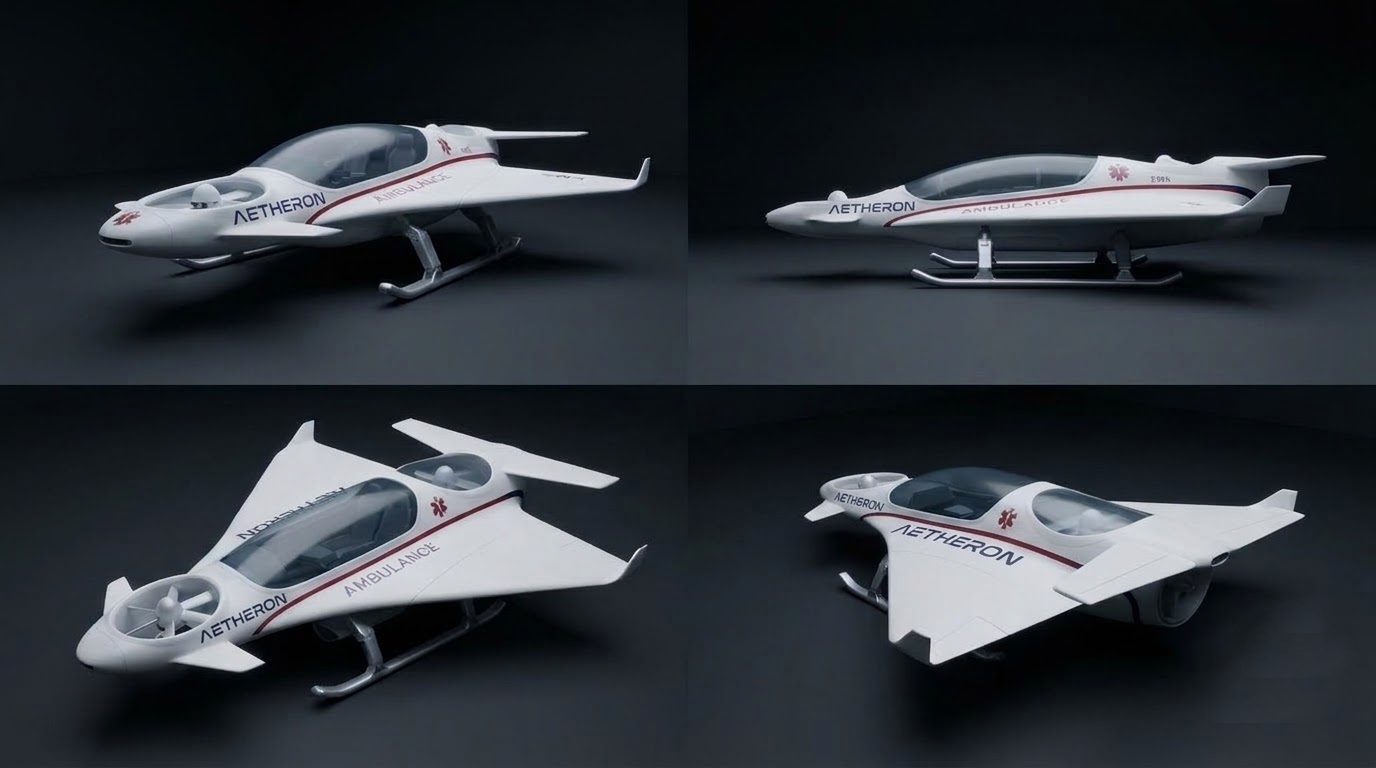
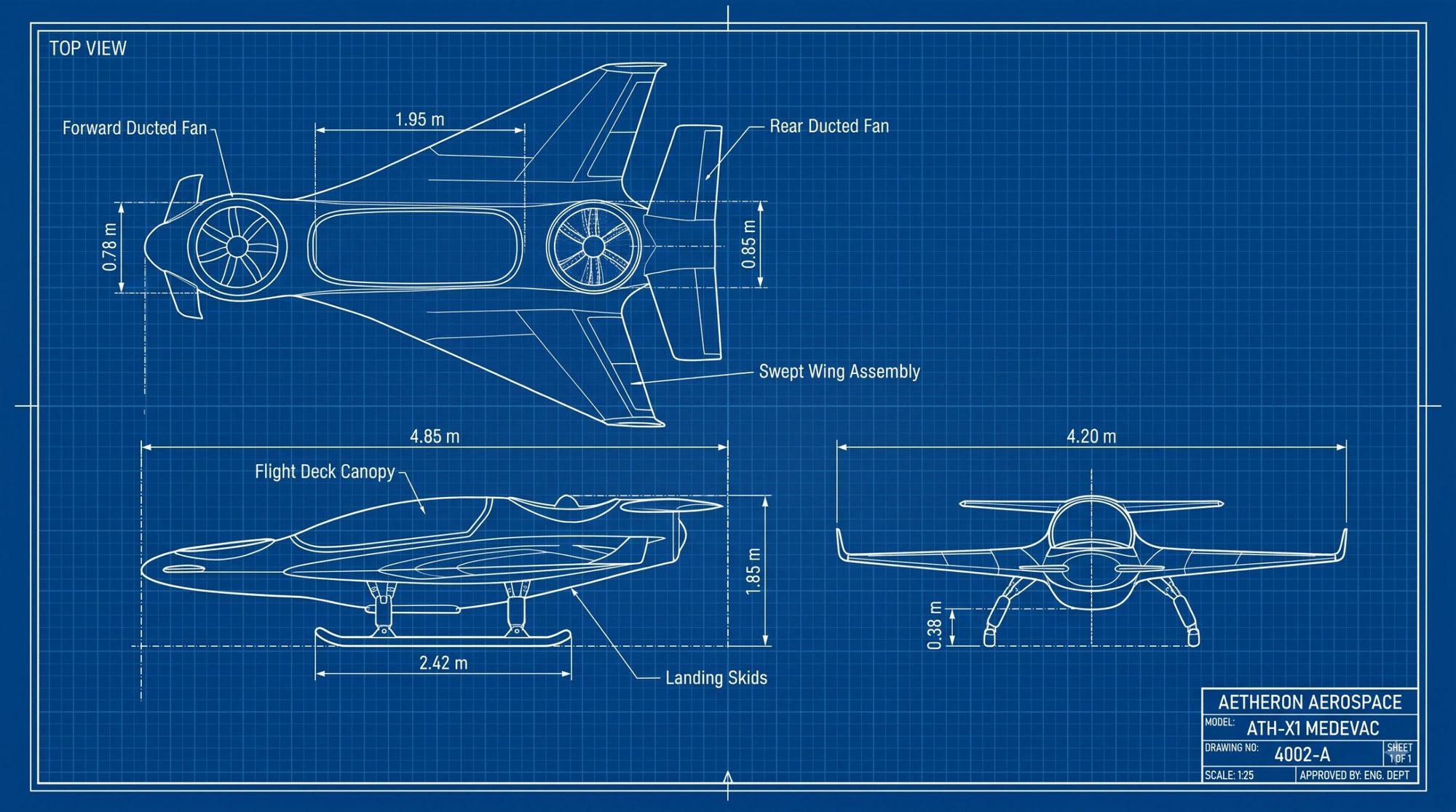
The airframe in three views.
A concept drawing of the long-term patient-carrying variant: a forward and a rear ducted fan, a swept wing assembly, a flight deck canopy and landing skids.
Built for the gap between multirotor drones and manned helicopters.
| Factor | Aetheron MediLift (tilt-rotor) | Manned helicopter air ambulance | Standard multirotor medical drone | Cargo VTOL (e.g. Elroy Air Chaparral) |
|---|---|---|---|---|
| Product type | Unmanned tilt-rotor VTOL | Manned helicopter | Multirotor cargo drone | Large unmanned cargo VTOL |
| Speed and range | Target: medium-high speed, long range | High / very long | Low-medium / short | High / long |
| VTOL, no runway | Yes | Yes | Yes | Yes |
| Operating cost | Target: low (no pilot, electric or hybrid) | Very high | Low | Not for medical use |
| Payload | Starts with 5–10 kg, scalable | 1–2 patients | Small boxes | Hundreds of kg of cargo |
| Patient-focused design | Yes, as the long-term goal | Yes | No | No |
| Made in India | Intended | Imported | Varies | No |
Competitor figures are from public information and will be checked in Q1. Telangana's Medicine from the Sky programme for BVLOS drone delivery of medical supplies shows state-level demand for this type of service (details to be verified).
A patient capsule that never flies as a hanging load.
The full-size version targets a payload of about 250 kg, including a patient, a rounded capsule and medical equipment. It is not part of the 12-month deliverable.
Arrive and hold
The aircraft arrives at the pickup point and holds position, or lands where space allows.
Lower the capsule
The capsule is lowered to the ground on four cables. Medical staff lay the patient on it and secure them.
Retract and lock
The capsule is fully retracted and rigidly locked to the belly by a redundant docking mechanism. The lock is electronically confirmed before forward flight.
Fly and hand over
The aircraft flies to the selected hospital under remote supervision and lowers or lands the capsule for handover.
The cables are used only for pickup and delivery. Cable handling, swing control, rotor downwash, lock redundancy and emergency release will be studied and tested without a patient first.
Prove the hardest part first: the hover-to-cruise transition.
The deliverable is a functional scaled tilt-rotor unmanned aircraft that makes a stable transition and carries a small medical payload of 5–10 kg.
Design and simulation
Finalise the tilt-rotor architecture, run CFD and flight-dynamics simulation of the transition, select motors and tilt servos, apply for the DGCA sandbox (cargo) and size the market.
Subsystem fabrication
Fabricate carbon fibre wings and fuselage, assemble the tilt mechanisms, integrate the flight controller with custom transition logic and run ground tilt tests.
Scaled flight testing
Tethered hover tests, then the first hover-to-cruise transition flights. Failsafes such as motor failure during transition are tested. If the transition proves too risky, the team falls back to a simpler hover plus fixed-wing configuration first.
Payload integration
Integrate a small medical payload pod for blood or organs, run an end-to-end mission test (take-off, cruise, land, retrieve) and prepare the data needed for the full-scale build.
From hospitals to farms to infrastructure.
From problem statement to compliant deployment, in seven stages.
Research & Conceptualization
Identify real-world problems and define engineering requirements.
System Architecture
Develop mechanical, electrical, electronic and software architectures.
Simulation & Digital Engineering
Evaluate concepts through CAD, robotics simulation and virtual testing.
Prototype Development
Build and integrate functional prototypes.
Autonomy Integration
Implement AI, navigation, perception and control systems.
Testing & Validation
Conduct controlled testing, safety assessment and performance validation.
Manufacturing & Deployment
Progress towards scalable production and compliant deployment.
Founders, engineers and advisors.
D. Pavan Kumar Varma
M.D., iView Designs. M.D., IQONIQO Designs Private Limited.
Rama Krishna Prasad Surapaneni
M.Tech in Advanced Production Systems and M.Tech in Manufacturing Management, BITS Pilani. General Manager, Virinchi Tool Tech.
Amitha
M.Sc. Electronics and Communication. Communication automation.
D. Venkateswara Raju
Ph.D. in Mechanical Engineering, University of Alabama. Professor of Mechanical Engineering and Dean, Industrial Consultancy and Sponsored Research, BVRIT Narsapur.
Dr. M. C. Chinnaiah
Ph.D., JNTUH, 2016 (FPGA-based robotic navigation). Professor, ECE, BVRIT Narsapur. Former research fellow, NTU Singapore.
Bhanu Prasad Gali
B.E. (Mechanical), PG in Tools Engineering, Central Tool Room, Kolkata. Founder director, PMI Toolings Pvt. Ltd. and Oilwell Tools Services and Supplies Pvt. Ltd.
To be identified
Emergency medicine and patient transport.
Not simply machines. Intelligent systems that change how the world moves and responds.
To become a globally recognized Indian technology company advancing autonomous aerospace, intelligent robotics and AI-driven mobility systems.
To research, design, develop and manufacture intelligent autonomous platforms that solve meaningful challenges across civilian, industrial, humanitarian and strategic sectors.
Combine human creativity with autonomous technology to create a better future.
Integrate mechanical, electrical, software and intelligent systems through research, engineering, experimentation and continuous innovation.
Designed with intelligence. Engineered with purpose. Built for the future.
Talk to Aetheron.
Get in touch to learn more about Aetheron Autonomous Systems and our flagship, MediLift.
This website describes the company’s intended vision, business scope and proposed development roadmap. It does not claim that all products, manufacturing facilities, certifications or operational capabilities are already established. Product development, testing, approvals and deployment will be undertaken subject to applicable laws, aviation regulations and safety requirements.
Aetheron MediLift is a concept-stage research and development proposal. The company does not claim that the aircraft is capable of transporting patients, or that it has been validated, certified or approved. The project seeks technical, regulatory and clinical support to develop and evaluate the technology through a staged engineering and safety programme. Patient transport will be considered only after separate approvals and safety validation.
© Aetheron Autonomous Systems. Aetheron MediLift is a product of Aetheron Autonomous Systems.